Stormwater Financing 2026


A proactive, Fair Share plan to reduce basement flooding for residents.
- In January 2025, the City of Windsor introduced a new way to pay for stormwater management, as those costs were previously combined with the wastewater fee on your ENWIN bill.
- The stormwater fee is based on each property’s water runoff contribution as a result of its total impervious area.
- This Fair Share plan is designed to create an equitable system for all properties.
City Sets New 2026 Rates
City Administration conducted a review of the stormwater financing program and reported back to City Council on Monday, November 24, 2025. Read the Council Report that was approved.
Below is a summary of the approved changes.
| Approved Amendments | Details |
|---|---|
| Shift in Rates | Implementation of a step‑based wastewater rate structure tied to water consumption and lowered stormwater rates for 2026 to ensure most residents pay less than in 2024. |
| Condominium Billing | Starting in 2026, residential units of qualifying condominiums will be billed individually through ENWIN instead of a single consolidated bill. |
| Retro Credit Deadline | Extended to June 30, 2026 for retroactive payment to January 1, 2025. |
| Agricultural Properties | Reallocation of farm property codes 200 and 201 to the tiered residential designation. |
| Stormwater Manual | Direct Discharge credit increased from 40% to 50%. Shared System Credit introduced for qualifying shared systems. Clarified equations and credit explanations. |
| Septic Phase‑in | Four‑year phase‑in with a 50% rebate starting January 1, 2026. |
What is stormwater?
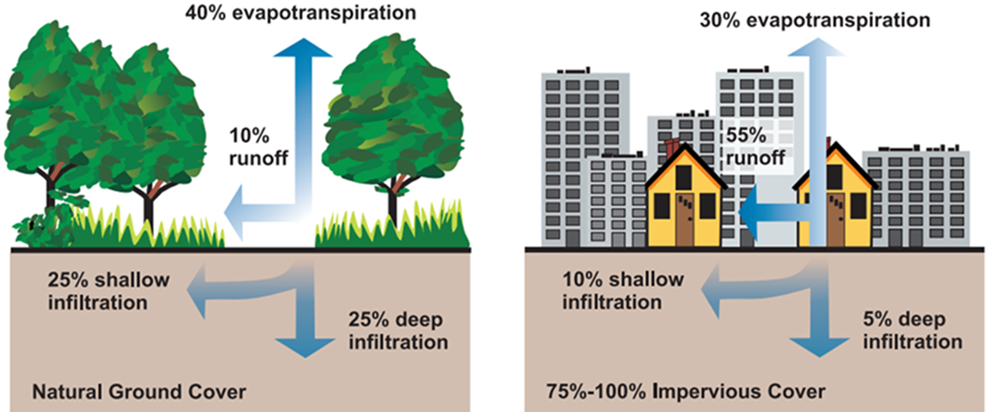
Stormwater is the water that flows into our sewers, creeks, and rivers after it rains or from melting snow. In natural areas, stormwater can soak into the ground where it lands or be absorbed by vegetation.
In urban areas, stormwater runs off hard surfaces such as rooftops, parking areas, patios, and sidewalks. As it flows, it can carry debris and chemicals into streams and rivers. Because water cannot soak into the ground, stormwater runoff in urban areas is greater in volume and moves more quickly, increasing the risk of flooding and erosion.
Pollutants carried in stormwater can enter the natural environment and negatively affect water quality and ecosystems.
Stormwater must be managed to reduce the risk of flooding and erosion, and to minimize harm to the environment.
Impact of stormwater on impervious areas:
What is the City’s role in managing stormwater?
The City is responsible for managing stormwater within the municipality. Stormwater management is key in protecting public safety and health, and works to reduce flood risk, control erosion and maintain water quality.
Managing stormwater includes planning, designing, constructing, operating and maintaining stormwater management structures. These structures consist of storm sewers, ditches, inlets, stormwater management facilities (ponds), bridges, culverts, infiltration facilities, oil grit separators, engineered and natural channels, and storm sewer outfalls to streams and watercourses.
The City’s stormwater management infrastructure
The City manages:
- More than 1,025 kilometres of pipes
- Approximately 15,300 sewer access holes
- More than 22,615 catch basins
- 29 stormwater ponds (wet and dry)
- 39 pump stations
- Approximately 124 kilometres of municipal drains
- Approximately 254 kilometres of roadside ditches
The estimated replacement cost value of the existing stormwater system is approximately $2 billion (in 2023 dollars).
Some of the City's management activities include the following:
- Undertaking flood protection projects
- Maintaining, repairing and restoring existing infrastructure
- Providing emergency response to flooding, spills and clean-up
- Carrying out street sweeping
- Enforcing by-laws to protect the environment and prevent interference with the stormwater management system
Good news for the environment and basement flooding:
The City's investment in the secondary treatment of wastewater at the Lou Romano Water Reclamation Plant will have significant environmental benefits by dramatically improving the quality of water discharged into the Detroit River. The recommendations from the sewer master plan will allow the City to continue to improve and add infrastructure to mitigate the effects of climate change and the inherent risks of flooding.
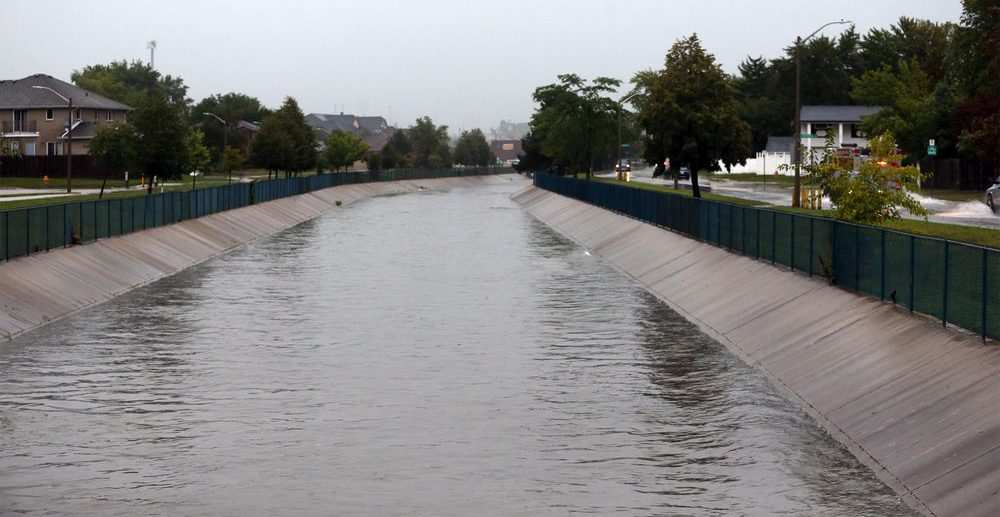 Extreme High Water Levels in Grand Marais Drain
 Stormwater Fee Credit Program Manual
A stormwater fee credit program was approved by Council as a financial incentive to non-residential and multi-residential properties. The credit program aligns with the City’s mandate to mitigate flooding and increase resiliency during storms, namely towards peak flow reduction, runoff reduction and water quality improvement. A credit is also available to non-residential and multi-residential properties that directly discharge their stormwater into the Detroit River or Lake St. Clair and do not use the municipal system. Learn more by reading the 2026 Stormwater Fee Credit Program Manual.
Credit application process: Stormwater Financing Program | City of Windsor
Stormwater Credit Supporting Documents
Incentives
An Incentives program exists for Residential property owners. Incentives programs are used to encourage voluntary actions by Residential property owners willing to make changes on their property to achieve a public objective of managing runoff and building flood resiliency. This Incentives Program offers a one-time financial incentive (per Property, per Program type) and is based on existing and new programs run by the City as follows:
1. Enhancement of Existing Subsidy Programs: claim limits were increased under the City’s subsidy programs including Basement Flooding Protection, Sanitary Sewer Private Drain Connection Replacement and Culvert Rehabilitation Subsidy Program. Click here to learn more: Sewers | City of Windsor
| Program | Item | Previous Amount | New Amount |
|---|---|---|---|
| Basement Flooding Protection Subsidy | Maximum (lifetime eligibility limit) | $ 2,800 | $ 3,500 |
| Sanitary Sewer PDC Replacement | Private sewer replacement - not w/in mandatory downspout disconnect area | $ 2,000 | $ 4,000 |
| Culvert Rehabilitation Subsidy program | Small (0-18" diameter) | $ 500 | $ 1,000 |
| Medium (18-48" diameter) | $ 1,000 | $ 2,000 | |
| Large (+48" diameter) | $ 2,000 | $ 3,000 | |
| Bridge | $ 5,000 | $ 7,500 |
2. Rain Barrel Program (new): A rebate of up to $120 on one rain barrel (limit one rain barrel per property owner) that is purchased by a residential property owner at their discretion. The rain barrel can be any make or model with a minimum volume of 132 Litres (35 gallons). Up to 500 properties can take advantage of this program each year. Click here to apply: Stormwater Financing Program | City of Windsor
Program Specifics:
- A receipt/invoice and photo of the installed rain barrel must be provided within the subsidy application
- Residents are responsible for the installation and maintenance the barrel
3.Tree Program (new): Each Residential property owner is entitled to one tree (limit one tree per property owner) for planting on their private property (i.e. not on the public right-of-way area). Trees will be available for pickup at a City Parks location in the Spring and Fall. Up to 200 trees will be available under this program each year. Click here to apply: Stormwater Financing Program | City of Windsor
What's Included:
- One (1) 7-gallon tree container, +/- 6'-0" tall
- Bag of mulch
- Planting guide
- Property map, outlining the parcel/right-of-way (ROW) boundary
Program Specifics:
- Tree species will be determined at scheduled pick up
- One (1) day pickup event in the Spring (3rd Saturday in May) and one (1) pickup event in the Fall (4th Saturday in October)
- Tree pick-up location - City of Windsor Greenhouse (2449 McDougall Street)
- No warranty will be provided.
- Residents are responsible for the installation and maintenance the tree
Tree Pick-up Options & Requirements:
- Owner Pick-up
- One (1) piece of government photo identification
- Signature from the individual picking the tree
- Authorized Representative Pick-up:
- An official letter from the property owner authorizing the individual to pick up the tree.
- One (1) piece of government photo identification
- Signature from the individual picking the tree
2026 Resident Frequently Asked Questions (FAQ)
1. Why is the City changing the stormwater & wastewater rate structure?
- The previous 2025 model aimed to ensure most residents paid less than in 2024, but some with lower-than-average water usage ended up paying more.
- To address this, Administration developed a step-based wastewater rate structure for 2026 tied to water consumption.
| Residential Wastewater Charges | |||
|---|---|---|---|
| 2025 | 2026 | ||
| Variable Consumption Charge | $2.01 (per cubic metre) | Variable Consumption Charge | Rate (per cubic metre) |
| 0 cubic metres | No charge | ||
| 1 - 5 cubic metres | $1.75 | ||
| 6 - 17 cubic metres | $3.40 | ||
| 18 - 30 cubic metres | $3.55 | ||
| >30 cubic metres | $3.58 | ||
| Fixed Charge | $12.89 | Fixed Charge | $12.89 |
| Non-Residential Accounts | |
|---|---|
| Wastewater Rates | 2026 Rates (no change from 2025) |
| Wastewater Fixed Charge | $116.57 for typical 1-inch service. See link below for further information |
| Wastewater Consumption Charge | $1.66 per cubic metre of water used (reduced for excess summer consumption) |
This change reduces the stormwater flat fee significantly, balancing overall charges. m2 = cubic metres.
| Residential Stormwater Changes | |||||
|---|---|---|---|---|---|
| 2025 | 2026 | ||||
| Residential Tier | Impervious Area | Monthly Billing | Residential Tier | Impervious Area | Monthly Billing |
| Tier 1 | 27 - 200 m2 | $22.50 | Tier 1 | 27 - 200 m2 | $8.00 |
| Tier 2 | 201 - 325 m2 | $28.17 | Tier 2 | 201 - 325 m2 | $10.00 |
| Tier 3 | 326+ m2 | $33.38 | Tier 3 | 326+ m2 | $12.00 |
2. Will residents pay less under the amended 2026 model?
- Most residents will pay less compared to 2024, but extreme water usage fluctuations may still result in higher bills for some.
- A step-based wastewater rate structure tied to water consumption will be introduced, along with a significant reductions to the stormwater flat fees.
- Most customers using between 1 and 40 cubic metres of water per month will pay less compared to 2024.
- About 3% of customers with zero or very high-water usage may see slight increases; causes for high water consumption could include leaks or faulty meters.
3. How are stormwater fees being phased in for properties on septic systems?
- Council approved a four-year phase-in period starting in 2025.
- A 75% credit was applied in 2025; for 2026, a 50% credit is recommended.
- Septic fees are not included in property taxes.
4. How will stormwater billing change for condominium owners & corporations?
- Currently, stormwater fees are billed to condominium boards based on the property’s impervious area.
- Under the proposed change, qualifying condominium units will receive individual stormwater bills.
- Criteria include:
- exclusively residential zoning;
- individual tax accounts; and
- individual ENWIN water bills for all units.
- Condominium properties that do not fall within the criteria below will continue with the existing billing structure
5.Will all agricultural properties be reclassified?
- Only properties under MPAC codes 200 and 201 will move to residential billing.
- Remaining agricultural parcels, which are generally associated with a commercial/non-residential designation, will remain in the current category.
- If there are concerns with your property designation, an MPAC assessment may be necessary to review your property.
- This approach aligns with stormwater program structure and Council’s directive.
- Exemptions remain for parcels with less than 27 square metres of impervious area.
6. My impervious area total is different from last year.
- The City completes annual flyovers to obtain updated impervious data each year
- If you believe that there has been an error on your impervious calculation, please complete the following:
- Visit the Stormwater Financing Calculator and search for your property to review the public mapping and assessed impervious area
- Submit an appeal through our online application portal at https://www.citywindsor.ca/EServices/Stormwater-Financing
7. I’ve used the online calculator to look at my property. The impervious area on the online calculator looks incorrect. How do I fix this?
- Aerial imagery is used to review and identify impervious areas. You are encouraged to notify the City of surfaces being incorrectly classified so that adjustments may be made for your property accordingly.
- Since tiers are used for residential rate structure, your stormwater fee may not change if you remain in the same tier.
- Please visit https://www.citywindsor.ca/EServices/Stormwater-Financing to initiate an Appeal to clarify the impervious area on your property.
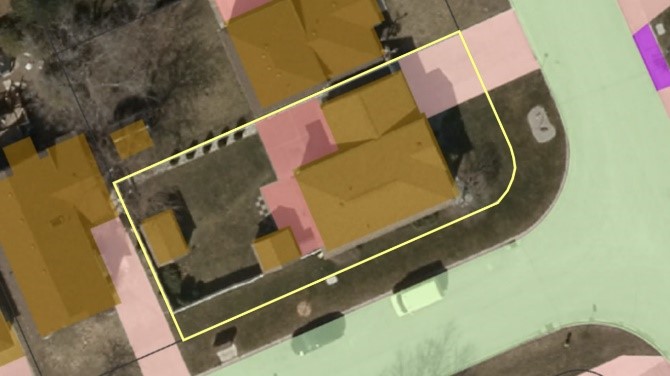
8. My neighbour’s impervious area is higher than mine, but we both pay the same amount. Why is this?
- Residential properties are billed on a 3-tier rate structure. The amount of impervious area on your property determines which tier you fall into. Properties of various sizes can exist in the same tier based on the amount of impervious area.
9. There is construction occurring on my property. When do you start charging the stormwater fee on a property?
- Impervious areas as a result of a site under construction (such as footings, staging areas, building under construction, etc) are not immediately considered for the calculation of the stormwater fee for that site.
- Impervious areas as a result of a site under construction (such as footings, staging areas, building under construction, etc) are not immediately considered for the calculation of the stormwater fee for that site.
- The stormwater charge will start to be billed based upon active use of the property, that is upon construction completion and/or occupancy as defined in the by-law.
- Aerial images taken on a yearly frequency and permit dates are some methods the City will use to identify when these impervious surfaces qualify and to calculate the fee based on these values.
- A property having less than 27m2 of impervious area is not subject to the stormwater fee.
10. What changes affect commercial/non-residential properties
- Direct Discharge Credits
- Maximum credit increased from 40% to 50%, exclusive of water quality.
- Properties not adjacent to the shoreline may qualify if they have a direct outlet at the discretion of the City Engineer.
- Extended Retro Credit Application Window – from January 1, 2026 to June 30, 2026
- NEW – Shared System Credit
- Allows separate properties that share one stormwater management system to apply for a credit.
- A new application form has been introduced to the Credit Manual to streamline the process.
- Eligibility requires an approved stormwater management report and a formal agreement between all participating properties.
11.Are any types of properties exempt from the Stormwater Fee?
- Since stormwater management is a public service used by everyone across the City, it is reasonable that everyone contributes.
- As a result, entities that are legally mandated to be exempt are not subject to the stormwater fee – this includes the public, Catholic, and French schoolboards.
- On April 28, 2025, Council approved providing Places of Worship and cemeteries a 60% exemption on their stormwater fee, effective to January 1, 2025. Qualifying properties must have one of the following MPAC property code designations: 314, 700, 701, 702, or 703. The revised stormwater fee with the 60% exemption will be applied on the Enwin utility bill.
12. What is stormwater?
- Stormwater is the water that flows into our sewers, creeks and lakes after it rains or from melting snow.
- In natural areas, stormwater can soak into the ground.
- In urban areas, stormwater runs off hard impervious surfaces (eg rooftops, parking areas, driveways, sidewalks, patios, compacted ground, etc.) and can increase the potential of flooding and erosion and also carry debris and chemicals into streams and rivers.
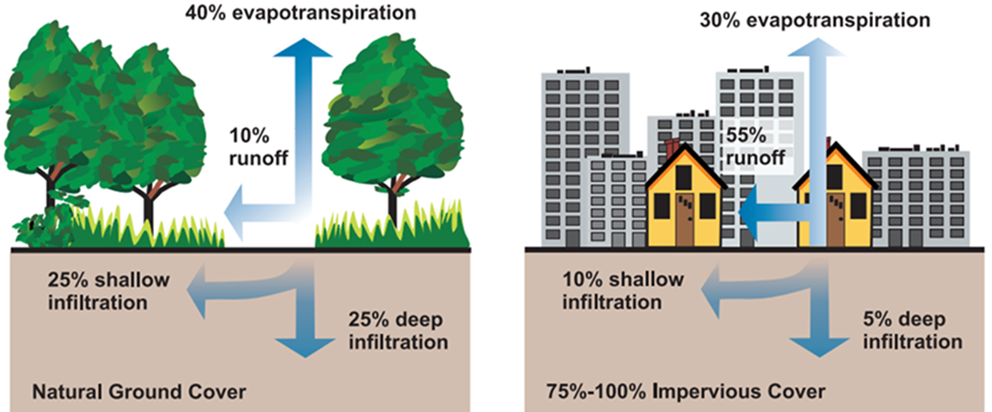 Source: Toronto and Region Conservation Authority (TRCA)
 13. What is wastewater?
- It is water that goes down your drains - including water from sinks, showers, toilets, appliances, etc.
14. What is the City’s role in managing stormwater?
- The City is responsible for managing stormwater within the municipality through the stormwater management program, including operating and maintaining storm sewers, ditches, inlets, stormwater management facilities (ponds), bridges, culverts, infiltration facilities, oil grit separators, engineered and natural channels, and storm sewer outfalls to streams and watercourses.
- The City’s stormwater assets include:
- More than 1025 km of storm sewer and combined sewer pipes
- Approximately 15,300 sewer maintenance holes and 22,615 catch basins
- 29 stormwater ponds (wet and dry)
- 39 pumping stations
- Approximately 124 km of municipal drains and 254 km of roadside ditches
- The estimated replacement cost value of the existing stormwater system is approximately $2 Billion.
15. What is the Wastewater & Stormwater Revenue Collected used for?
- The wastewater & stormwaters budget are approved during the City’s annual budget process. The 2026 Budget report will be posted on the Stormwater web page once the 2026 Budget Agenda is released.
16. What are the impacts to local property owners?
- The new funding model and rate structure will provide a more equitable and sustainable funding source for the stormwater program than the previous model of paying for stormwater costs using sewer surcharges related to water usage.
- This is not a new fee for residents who were paying the sewer surcharge – the previous water bill already included a single combined fee called Wastewater Charges that funded both the stormwater and wastewater programs.
- The stormwater fee is applicable to all properties in the City as it is a charge for a public service. The service is a benefit to everyone, regardless of direct connection or usage of the City’s stormwater management system.
17. How can I find out more information on the Project?
Additional communications are within this page and through the City of Windsor’s social media platforms. Stormwater and wastewater fee rates are outlined in the sections below. Property owners can also view the impervious area on their property and the corresponding stormwater fee using the Stormwater Financing Calculator tool.
For general questions, please contact 311 or email the City Project Team at rowprograms@citywindsor.ca. For billing related questions, please contact ENWIN Call Centre at 519-255-6903 or email: info@enwin.com.
2026 Billing Frequently Asked Questions (FAQ)
The City of Windsor previously funded both wastewater and stormwater projects through the Sanitary Sewer surcharge, which was based on water consumption. In January 2025, the City separated the Sanitary Sewer surcharge to create dedicated funding models for wastewater and stormwater, introducing a new method to fund stormwater management based on impervious area on a property. Implementing a dedicated stormwater funding plan using a new financial model for the calculation helps to address the impacts of heavy flooding events the City experienced in 2016 and 2017 and allows for the implementation of the City’s Sewer Master Plan to address flooding in a more focused way. Please visit the online calculator tool to view your property and see how the stormwater fee for your property was calculated.
1. My ENWIN utility bill looks different. What are Wastewater and Stormwater charges?
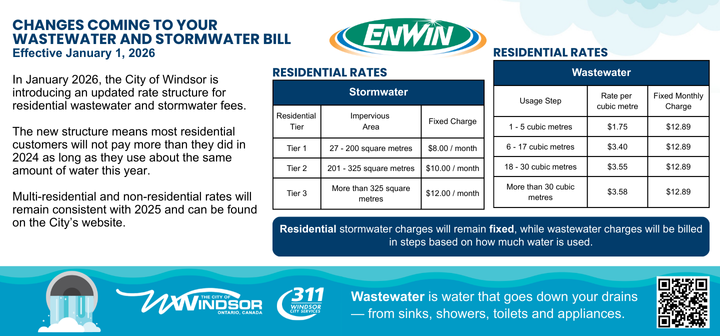
Beginning in January 2025, the City has broken out wastewater and stormwater funding and how it charges for these services. In 2026, the City is introducing an updated rate structure for residential wastewater and stormwater fees. The new structure means that most residential customers will not pay more than they did in 2024, as long as they use about the same amount of water. Stormwater charges will remain fixed, while wastewater will now include a fixed charge and usage steps based on the amount of wastewater you produce. The differences in your bill are shown below, comparing the 2025 bill with the new 2026 bill:
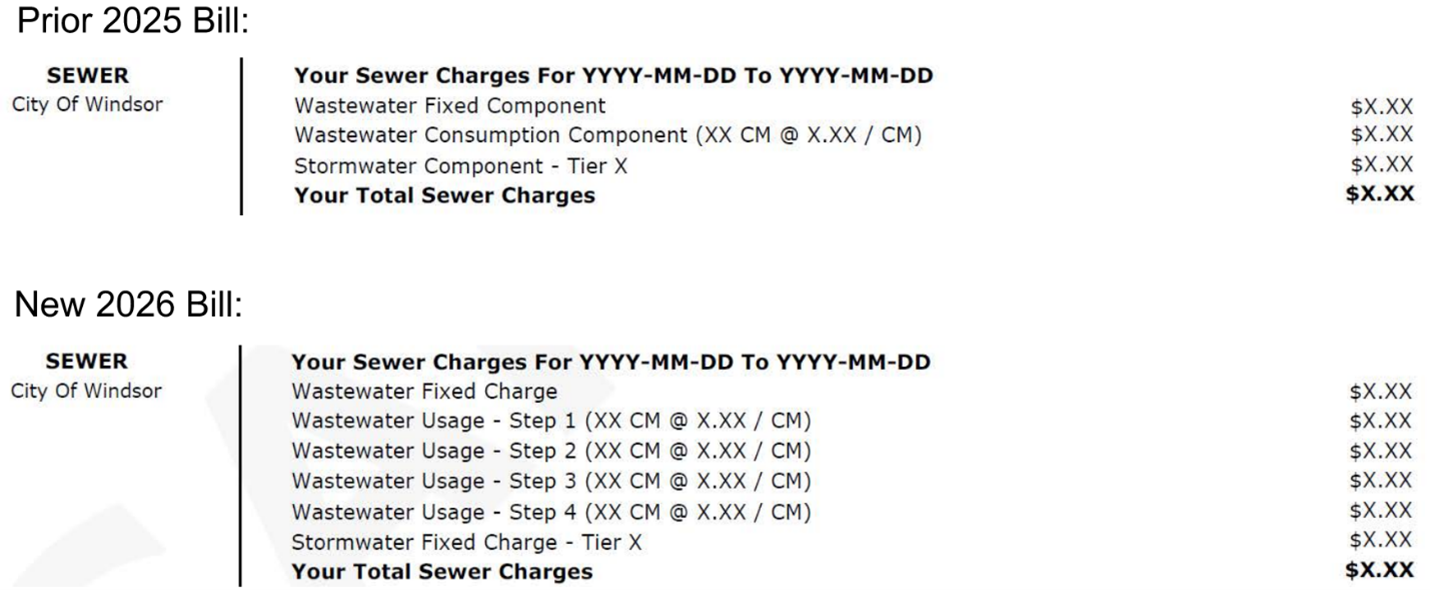
2. How are the Wastewater Rates Changing on January 1, 2026?
To balance the impact that water consumption has on the overall combined wastewater & stormwater charge, City Council approved a step-based structure for wastewater rates which is directly related to water consumption. The offsetting effect of this graduated wastewater rate is a significant decline in the stormwater flat fee. This results in most customers using the same volume of water will pay no more than they did in 2024 for their combined wastewater & stormwater fees. The 2025 and new 2026 Wastewater rates are detailed in the table below:
| Residential Wastewater Charges | |||
|---|---|---|---|
| 2025 | 2026 | ||
| Variable Consumption Charge | $2.01 (per cubic metre) | Variable Consumption Charge | Rate (per cubic metre) |
| 0 cubic metres | No charge | ||
| 1 - 5 cubic meters | $1.75 | ||
| 6 - 17 cubic metres | $3.40 | ||
| 18 - 30 cubic metres | $3.55 | ||
| >30 cubic metres | $3.58 | ||
| Fixed Charge | $12.89 | Fixed Charge | $12.89 |
| Non-Residential Accounts | |
|---|---|
| Wastewater Rates | 2026 Rates (no change from 2025) |
| Wastewater Fixed Charge | $116.57 for typical 1-inch service. See link below for further information |
| Wastewater Consumption Charge | $1.66 per cubic metre of water used (reduced for excess summer consumption) |
The stormwater and wastewater fee rates are subject to City Council approval each year.
3. Why does my January bill have two lines for sewer charges? Why was I charged two different rates?
The first ENWIN bill for January of any year is likely to include a billing period that spans December of the previous & January of the current year, with rate changes taking effect January 1. The wastewater fixed costs and stormwater fees will be prorated based on the number of days spanning January & December. If you have any additional questions, please contact ENWIN Call Centre at 519-255-6903 or email: info@enwin.com.
4. Should I compare my bill to the same month last year?
To understand the changes to your bill changes to your bill, you should compare the year-over-year total annual costs rather than on a monthly comparison. Charges on your bill depend on monthly water usage fluctuations which may differ drastically for various reasons such as things like weather and time away from the home. If you have any additional questions, please contact ENWIN Call Centre at 519-255-6903 or email: info@enwin.com.
5. Does my water usage impact whether I’ll see an overall reduction on my bill compared to 2024?
Each individual property’s actual water usage will impact the charges on your bill. On average, it is estimated that most residents won’t pay more than they did in 2024, if water usage remains consistent with the previous year. However, in some cases, such as those properties which use a very low or very high amount of water, they may see an increase in their overall sewer surcharge fee.
6. I’ve used the online calculator to look at my property. The impervious area on the online calculator looks incorrect. How do I fix this?
The calculation for the stormwater fee is based on the amount of impervious surfaces on the site. The City uses aerial imagery to review and identify impervious areas. You are encouraged to notify the City of surfaces being incorrectly classified so that adjustments may be made for your property accordingly. Visit https://www.citywindsor.ca/EServices/Stormwater-Financing to initiate an appeal to clarify the impervious area.
7. My neighbour’s impervious area is higher than mine, but we both pay the same amount. Why is this?
Residential properties are billed on a 3-tier rate structure. The amount of impervious area on your property determines which tier you fall into.
- Tier 1: any property having between 27-200 sqm of impervious area will pay a monthly rate of $8.00/month (or $96/year). Tier 1 represents the smallest 25% of residential properties (by impervious area) across the City.
- Tier 2: any property having between 201-325 sqm of impervious area will pay a monthly rate of $10.00/month (or $120/year). Tier 2 represents the middle 50% of residential properties (by impervious area) across the City.
- Tier 3: any property having more than 325 sqm of impervious area will pay a monthly rate of $12.00/month (or $144/year). Tier 3 represents the largest 25% of residential properties (by impervious area) across the City.
8. I’m not connected to the sewer system. Why am I being charged the stormwater fee?
Since stormwater management is a public service used by everyone across the City, it is reasonable that everyone contributes. This is a fair distribution of cost for flood reduction mitigation and proper functioning of the City’s infrastructure assets as everyone benefits from a well operating drainage system. The amount of the fee is based on the amount of impervious area on your property. In cases where an ENWIN utility bill did not previously exist for a property, a new one was issued.
Residents that didn’t previously pay the sewer surcharge, such as those on septic systems, will see an increase based on their rate structure, and will now contribute to funding the stormwater management program. Septic systems have an impact on the City’s stormwater systems. For example, some septic beds may seep into the ground and can affect the groundwater table and its capacity to hold more water, or some have overflow discharges into drains and ditch systems that are ultimately maintained by the City. It is estimated there are around 520 residential properties that have a septic system.
On April 28, 2025, Council approved a 4-year phase-in period for the stormwater fee to residential property owners on septic systems, with a 50% subsidy being offered in 2026, effective to January 2026. The rebate will be applied on your EnWin utility bill. Furthermore, credit programs for non-residential and multi-residential properties exist and can be found at https://www.citywindsor.ca/EServices/Stormwater-Financing
9. Are any types of properties exempt from the Stormwater Fee?
Since stormwater management is a public service used by everyone across the City, it is reasonable that everyone contributes. As a result, entities that are legally mandated to be exempt are not subject to the stormwater fee – this includes the public, Catholic, and French schoolboards.
Also, following Administration’s review of the exemption policy, on April 28, 2025, Council approved providing Places of Worship and cemeteries with a 60% exemption on their stormwater fee, effective to January 2025. Qualifying properties must have one of the following MPAC property code designations: 314, 700, 701, 702, or 703. The revised amount is applied on the EnWin utility bill.
10. There is construction occurring on my property. When do you start charging the stormwater fee on a property?
Impervious areas as a result of a site under construction (such as footings, staging areas, building under construction, etc.) are not immediately considered for the calculation of the stormwater fee for that site. The stormwater charge will start to be billed based upon active use of the property, that is upon construction completion and/or occupancy as defined in the by-law. Aerial images taken on a yearly frequency and permit dates are some methods the City will use to identify when these impervious surfaces qualify and to calculate the fee based on these values.
11. How does the Funding Model and Rate Structure work?
Under the approved funding model, the amount of impervious area on a property is used as the meter to determine the stormwater fee. Impervious surfaces include those which don’t allow the natural infiltration of water into the ground, and can include buildings, driveways, sidewalks, patios, parking lots, compacted ground, material stockpiles, and accessways.
Residential properties are grouped into tiers (e.g., low, medium, high) based on their measured impervious area where each tier has a fixed rate. Non-residential properties are charged based on the measured impervious area on each parcel. The new funding model and rate structure provide an equitable and sustainable funding source for the future stormwater program.
In recent years, the City’s previous sewer surcharge model allocated 55% of the cost of stormwater and wastewater services to residential customers and 45% to non-residential customers. The City’s historic approach of funding stormwater services through the sewer surcharge rate did not fairly distribute costs between these two high-level property classifications and, as a result, residential properties effectively paid a higher burden of program costs than non-residential properties.
With a shift to the new rate structure introduced in 2025, the revenue generation for stormwater services is approximately 42% from residential customers and 58% from non-residential customers. This is aligned with the share of impervious areas associated with properties across the City and consistent with the approach adopted by municipalities across Canada and the United States.
12. How can I find out more information on the Project?
Additional communications are available online and through the City of Windsor’s social media platforms.
Property owners can view the impervious area on their property and the corresponding stormwater fee using the online calculator tool, which can be accessed through this project website or directly at https://CityW.ca/StormwaterFeeCalculator.
For general questions, please contact 311 or email the City Project Team at rowprograms@citywindsor.ca.
For billing related questions, please contact ENWIN Call Centre at 519-255-6903 or email: info@enwin.com.
Stormwater Rates
Your stormwater fee is based on the impervious area of your property. The following stormwater rates will be applied on your ENWIN water bill in starting in January 2026.
Residential properties: Tiered flat rate based on impervious area.
| Residential properties: Tiered flat rate based on impervious area. | ||
|---|---|---|
| Residential Tier | Impervious Area | Monthly Billing |
| Tier 1 | 27 - 200 m2 | $8.00 |
| Tier 2 | 201 - 325 m2 | $10.00 |
| Tier 3 | 326+ m2 | $12.00 |
Non‑Residential & Multi‑Residential: Fee based on amount of impervious area.
| Non-Residential and Multi-Residential/ Monthly Flat Rate* | |
|---|---|
| Per Square meter | $ 0.105 /m2 |
* Equivalent annual rate of $1.26 /m2
Wastewater Rates
Building upon the direction of City Council (CR177/2025) and in an effort to ensure that most residents will continue to pay less for their combined wastewater & stormwater costs than they did in 2024, City Council has approved a step-based structure to the wastewater rates in 2026, which is directly related to water consumption. The offsetting effect of this graduated wastewater rate is a significant decline to the stormwater flat fee. The Wastewater Fee is calculated using Stand-Alone Uniform Sewer Rates. This is made up of the Wastewater Fixed Charge that is based on the size of the meter connected to your address (outlined below) and a Wastewater Consumption Charge based on water usage. In order to exclude increased summer water usage that is estimated not to be returned to the sewer system, the water usage for the wastewater consumption charge will be calculated as the lower of actual water usage or the winter average usage.
For the period from November 1 through to April 30 (known as the winter consumption), the actual consumption of water is charged at a rate per cubic metre of water.
For the period from May 1 through to October 31 (known as the summer consumption), the actual summer consumption of water is also charged at a rate per cubic metre but is reduced by any excess summer usage above the winter average usage consumption of water. (Note: Therefore, charges do not include increased summer consumption costs related to watering the garden, filling pools, washing cars, etc. during this period).
The wastewater rates are listed below:
Residential Accounts:
Residential Wastewater Charges: | |||
|---|---|---|---|
| 2025 | 2026 | ||
| Variable Consumption Charge | $2.01 (per cubic metre) | Variable Consumption Charge | Rate (per cubic metre) |
| 0 cubic metres | No charge | ||
| 1-5 cubic metres | $1.75 | ||
| 6-17 cubic metres | $3.40 | ||
| 18-30 cubic metres | $3.55 | ||
| >30 cubic metres | $3.58 | ||
| Fixed Charge | $12.89 | Fixed Charge | $12.89 |
Non-Residential Accounts:
| Non-Residential Accounts | |
|---|---|
| Wastewater Rates | 2026 Rates (no change from 2025) |
| Wastewater Fixed Charge | $116.57 for typical 1-inch service. See link below for further information |
| Wastewater Consumption Charge | $1.66 per cubic metre of water used (reduced for excess summer consumption) |
| Wastewater Fixed Charge (Commercial) | Stand-Alone Fixed Wastewater Charge |
|---|---|
| Less than 1 inch/25 millimetres (mm) | $12.89 |
| 1 inch/25mm | $116.57 |
| 1 1/2 inch/40mm | $273.07 |
| 2 inch/51mm | $455.84 |
| 3 inch/75mm | $819.25 |
| 4 inch/100mm | $1,450.72 |
| 6 inch/150mm | $2,648.92 |
| 8 inch/200mm | $4,413.61 |
| 10 inch/250mm | $7,270.84 |
| 12 inch/300mm | $10,470.00 |
Residential Example: Residential Customer Using 18 cubic metres (m3) of water/month in the summer with a winter average of 12 m3 of water/month. The fixed charge portion of the wastewater fee will be $12.89 for residential customers.
The consumption charge portion of the wastewater fee during the winter period (November 1 – April 30) is calculated as follows:
| Usage Step 1: | 5 m3 at $1.75 | $8.75 |
| Usage Step 2: | 12 m3 at $3.40 | $40.80 |
| Usage Step 3: | 1 m3 at $3.55 | $3.55 |
| Actual Water Usage: | 18 m3 | $53.10 |
The consumption charge portion of the wastewater fee during the summer period (May 1 – October 31) is calculated as follows:
| Usage Step 1: | 5 m3 at $1.75 | $8.75 |
| Usage Step 2: | 12 m3 at $3.40 | $23.80 |
| Wainter average water usage: | 12 m3 | $32.55 |
Total wastewater charges during winter period (fixed + consumption) = $65.99
Total wastewater charges during summer period (fixed + consumption) = $45.44
Non-Residential Example: Commercial customer using 1,000 m3 of water/month in the summer with a winter average of 900 m3 of water/month. The fixed charge portion of the wastewater fee will be $116.57 for a customer with a 1-inch service.
The consumption charge portion of the wastewater fee during winter period (November 1 – April 30) is calculated as follows:
| Actual water usage (1,000 m3 of water at $1.66/m3) | $1,660.00 |
The consumption charge portion of the wastewater fee during summer period (May 1 – October 31) is calculated as follows:
| Actual water usage (900 m3 of water at $1.66/m3) | $1,494.00 |
Total wastewater charges during winter period (fixed + consumption) =$1,776.57
Total wastewater charges during summer period (fixed + consumption) =$1,610.57
Why does the wastewater fee also include fixed charges and not just water usage?
Fixed charges to connect to the water system are also factored into the calculation of the wastewater fee, as they are an integral part of the entire water distribution process. There are both costs that fluctuate with the amount of water that is discharged into the sewer system and costs that are fixed in nature that need to be funded no matter what the usage levels are. However, approximate 70% of the wastewater amount is based on the amount of water actually used.
Allocation of Fixed and Variable Costs
The way the wastewater fee is calculated was changed in 2009 to better reflect the amount of water the consumer actually uses. In order to be more closely aligned with the provincial average as it relates to the fixed/consumption fee ratio for sewer charges, the formula is based on approximately 30 percent fixed cost and 70 percent consumption cost for average residential water users. Consumers are able to better manage their wastewater costs by reducing their water consumption. Lower water consumption will reduce the strain on the sewer infrastructure, which could delay the need for future capital expenditures, thus saving money over the long term.
Allocation Between Residential and Commercial Customers
Consideration was again given in this year’s review to the proportion of costs assigned to residential and commercial customers. Historically, water consumption has typically been split 47% and 53% respectively between residential and commercial customers based on actual usage. The 2025 wastewater fee model has been developed with a cost split of 55% residential and 45% commercial, which is keeping in line with the cost split in the prior year. This split will continue to be assessed annually, as usage patterns stabilize from the COVID-19 pandemic impacts, with the goal of a continued shifting in future years until the model is aligned with the actual consumption-based allocation.